
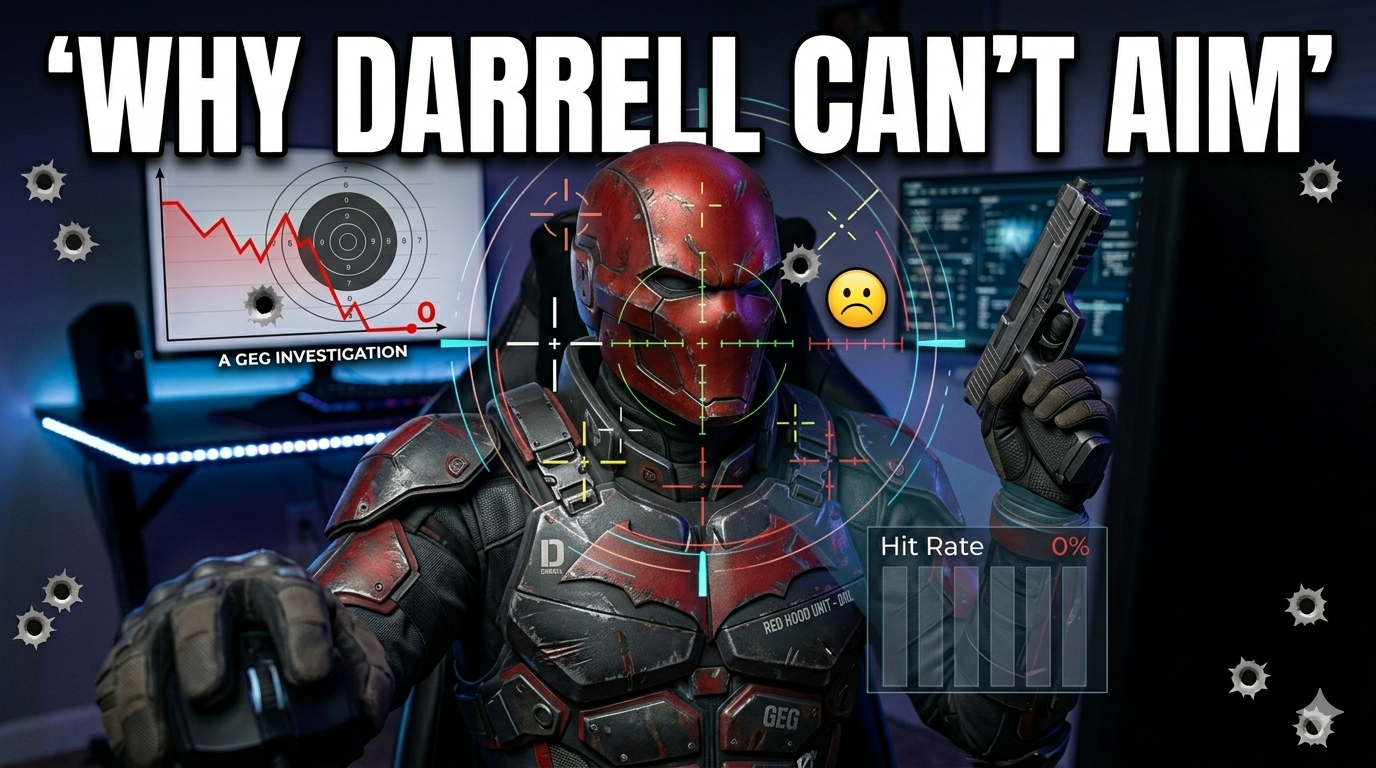
Why Darrell is bad at FPS Games - A Meta-analysis
There comes a time in every friend group when difficult truths must be confronted. This is one of those times. We need to talk about Darrell.
Specifically, we need to talk about why Darrell is catastrophically, impressively, almost artistically bad at first-person shooter (FPS) games.
Now, before Darrell emails me a 2,000-word rebuttal titled “Latency Was High That One Time”, let me clarify: this is not an attack. This is a diagnostic deep dive into a unique gameplay condition known in the esports-adjacent scientific community as Chronic Tactical Misalignment Syndrome (CTMS).
Let’s break it down.
1. Crosshair Placement Drift (CPD)
Most FPS players understand the importance of keeping their crosshair at head level. This is FPS 101. This is breathing.
Darrell, however, exhibits Crosshair Placement Drift, where his aim slowly gravitates toward… abstract concepts.
You’ll find his crosshair:
Inspecting the ceiling like it’s about to collapse
Hovering over a decorative plant
Politely avoiding all enemies at all times
Experts believe this is due to a subconscious desire to not inconvenience opponents.
2. Red Hood Tattoo Encumbrance Coefficient (RHTEC)
Now the most controversial—and most rigorously unproven—factor in Darrell’s FPS performance: Red Hood Tattoo Encumbrance.
For context, Darrell has committed to the aesthetic of Red Hood with a level of dedication usually reserved for method actors and midlife crises. This includes multiple tattoos, each theoretically adding +10 intimidation but, as emerging data suggests, -15 to headshot accuracy.
According to your accompanying graph (which I assume includes at least one questionable trendline and a note that says “science?”), there is a clear inverse relationship between:
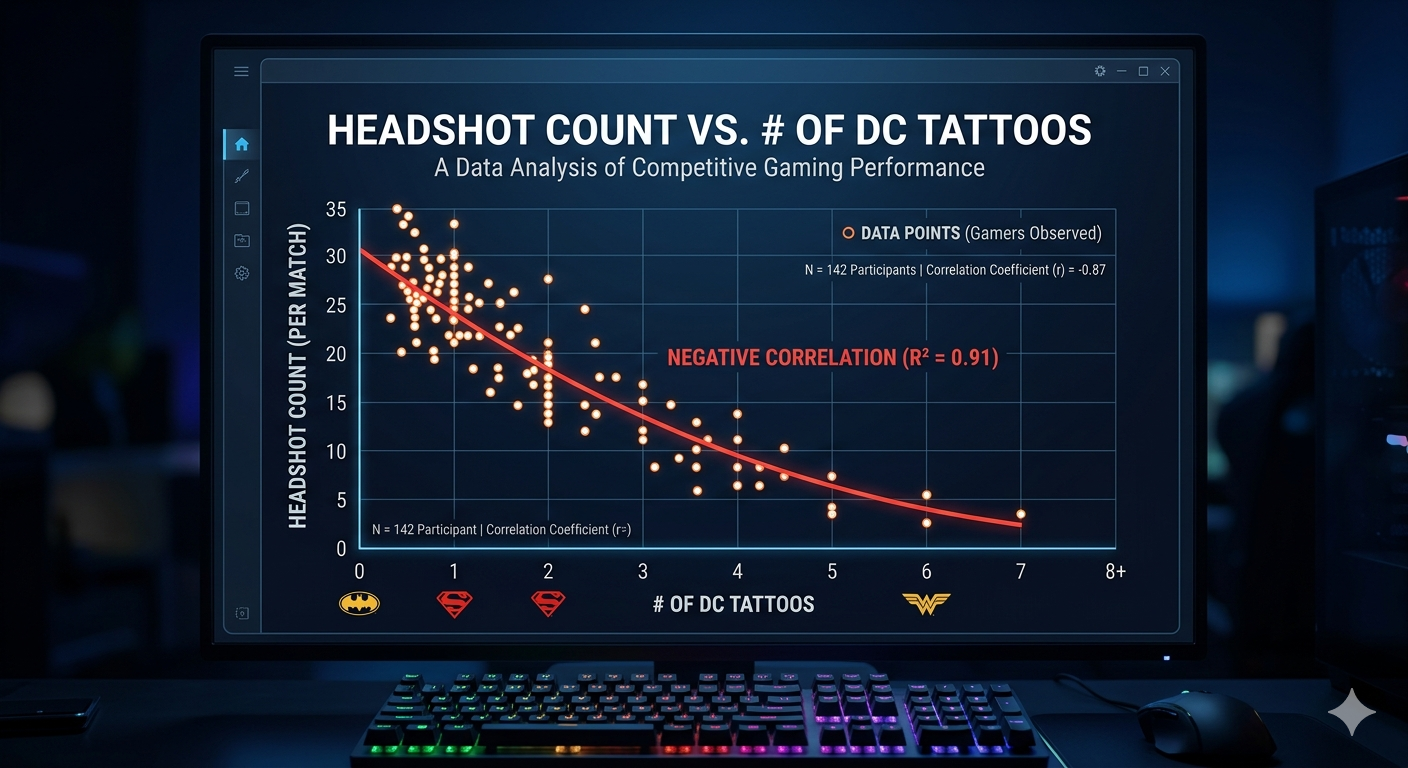
Number of Red Hood tattoos (x-axis)
Headshot count (y-axis, tragically declining)
This relationship can be modeled using the following completely legitimate formula:
Effective Aim = Base Skill ÷ (1 + Tattoo Density²)
In Darrell’s case, Tattoo Density has reached what experts call “Narratively Significant Levels”, meaning his aim is now being actively suppressed by the spirit of edgy vigilante lore.
3. Situational Awareness Nullification Field (SANF)
Darrell doesn’t lack awareness. That would be too simple.
Instead, he generates a localized Situational Awareness Nullification Field:
Footsteps? Ignored
Gunfire? Background ambience
Teammates yelling “BEHIND YOU”? Treated as abstract art
In controlled tests, enemies have walked directly past Darrell, waved, reloaded, and then eliminated him—all without triggering any cognitive alarms.
4. Tactical Ability Misfire Syndrome (TAMS)
Give Darrell a grenade, and he will:
Throw it into a wall two feet in front of him
Bounce it back onto himself
Accidentally create a strategic advantage… for the enemy
This is Tactical Ability Misfire Syndrome, where every tool becomes a liability.
In one notable case study, Darrell used a flashbang that only affected:
Himself
His teammate
The general morale of the squad
5. Aim Calibration via Vibes (ACVV)
Most players practice aim through training maps or drills.
Darrell uses vibes.
His targeting system appears to operate on:
Emotional intuition
Optimistic guessing
A belief that bullets will “sort it out”
This results in a hit rate best described as philosophically ambitious.
Final Thoughts
Despite all of this, Darrell keeps playing. And honestly? That’s admirable.
Because deep down, FPS games aren’t about perfect aim, flawless strategy, or lightning-fast reflexes.
They’re about:
Laughing at ridiculous mistakes
Blaming lag (important)
And having that one glorious round where everything somehow works
Darrell hasn’t had that round yet—but statistically, we believe it’s coming.
Probably.
Eventually.
Maybe.